Skip to Content

 SUGAR SHS / GKP 

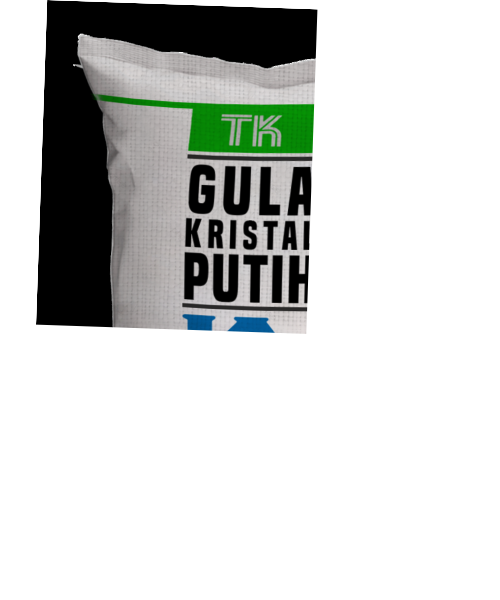
  SHS Sugar / GKP as our flagship product comes with a premium taste. Our SHS Sugar meets national standards and is halal.

Request a Quote

Description


SHS stands for Superium Hoofd Suiker (in Indonesian: Super Class Sugar, one of the flagship products of PT Kebon Agung is SHS Sugar). The term SHS comes from the Dutch language because the majority of sugar factories in Indonesia are remnants of the Dutch colonial era, so the term given by the Dutch is still used. The sugar is packaged in bags with a net weight of 50 kilograms. The quality of the produced sugar has undergone testing and certification according to the Indonesian National Standard (SNI). In addition, it has also been certified Halal by MUI, making this crystal sugar product proven safe for consumption by the public. 

Raw Materials

The raw material used in the production of crystal sugar is sugarcane (Saccharum Officinarum), which can grow in paddy fields, land, and areas with tropical and subtropical climates. The part of the sugarcane plant that will be processed is the stalk, which contains sugar (Sucrose). The yield value of sugarcane is an important factor in sugar production. The higher the yield, the more sugar is produced. 

The factors that influence sugarcane yield are soil conditions, climate, rainfall, altitude, variety, crop maintenance, transportation, and handling before milling.

Sugarcane is classified as:

  • Family: Poaceae
  • Sub Family: Andropogoneae
  • Genus: Saccharum
  • Species: Saccharum officinarum

Sucrose is a carbohydrate that is classified as a disaccharide. Sucrose is produced from the biochemical synthesis of two monosaccharides, namely D-Glucose and D-Fructose.

The monosaccharides that form sucrose are produced from the photosynthesis process of CO2 gas and H2O with the help of sunlight. The management of the environment and the supply of raw materials are handled by the harvesting and transportation section of the plant.

To control the quality of the cane, the factory stipulates that the sugarcane allowed for milling must meet the MBS requirements:

  1. M: (Manis) Sweet, the sugarcane must be ripe or mature.
  2. B: (Bersih) Clean, the harvested sugarcane sent to the factory must be free from impurities (leaves, shoots, roots, soil, etc.).
  3. S: (Segar) Fresh, the time from when the sugarcane is cut until it enters the mill should be less than 36 hours.

Supporting Materials

 Some auxiliary materials in the process of sugar production.

  1. Imbibition Water Imbibition water is used to extract the juice contained in sugarcane at the Milling Station and to concentrate the juice in the subsequent process, so that the content of the bagasse can be minimized.
  2. Quicklime (CaO) Quicklime (CaO) is the basic material for making lime milk. Quicklime functions to bind non-sugar compounds in raw juice, making it easier to separate the juice from its impurities. The addition of lime milk will make the juice more stable during the heating process and less prone to hydrolysis. The process of making lime milk involves adding quicklime into a rotary drum and spraying it with hot water.
  3. Sulfur Sulfur is used as a material for producing SO2 gas in the combustion of sulfur with limited air. SO2 gas is used for the purification process through sulfitation. Sulfur is burned in a sulfur furnace and liquefied with steam, then air is introduced to form SO2 gas.
  4. Flocculant Flocculant is a material used to accelerate the sedimentation process, where in the juice solution, suspended colonies and flocs (colloids) will form, leading to the sedimentation process. The type of flocculant used is Acofloc.
  5. Sodium Hydroxide (NaOH) Sodium hydroxide is used in the Evaporation Station (evaporator) and heating, which functions to help remove or soften scale on the evaporator and heating pipes.


Production Process

The process of sugar production from sugarcane involves a series of complex steps. Here are some of the phases of its production, 

  1. Sugarcane: Carrying out the process of planting sugarcane until the harvest process arrives.
  2. Scale: The sugarcane that is ready for harvest will enter the weighing process stage according to the applicable procedures.
  3. Grinding: The sugarcane is first crushed and ground to separate the juice or sugar water from its fibers. The result of this grinding is called "sugarcane flour" or "beet flour."
  4. Purification: Cane juice or sugar beet juice obtained from pressing is then purified through a series of processes, including sedimentation, filtration, and chemical purification. This process aims to remove impurities, wax, and other unwanted components from the juice, resulting in a purer sugar solution.
  5. Evaporation: The produced sugarcane or beet pulp is then pressed to separate the sugarcane or beet juice from its fibers. The resulting juice is rich in sucrose, which is a natural sugar.
  6. Crystallization: The purified sugar solution is then heated to remove some of its water and turned into a concentrated solution. Next, crystallization is performed by crystallizing the sugar from the concentrated solution using precipitation or separation by centrifugation. This results in raw sugar crystals.
  7. Advanced Purification: The raw sugar crystals produced are then further refined through a series of processes, including drying, filtering, and bleaching, to produce fine white sugar with high purity.
  8. Finishing: The finished white sugar is then packaged in suitable packaging, ready to be distributed to the market.


Quality Supervisor


  1. Raw Material Quality Control Analysis aims to determine when the sugarcane is ready to be harvested, which is assessed based on the sugarcane factors, the coefficient of durability (KDT), and the coefficient of improvement factors.
  2. Milling Process Quality Control The quality control of the milling process aims to obtain as much sugarcane juice as possible and to minimize the amount of sugar remaining in the bagasse.

a. Determination of % Brix price Analysis procedure:

  • The sample of sap is placed in a brix beaker until full and allowed to sit so that larger impurities settle.
  • Brix Weighner is placed in the brix cup.
  • The scale is observed in a stable condition (5 minutes), the brix scale, weight, and temperature are recorded.
  • From the brix scale and the sap temperature, the corrected brix value can be determined with the help of a table.

b. Price determination % Pol Analysis procedure:

  • The sample of sap is placed in a 100 ml volumetric flask, up to the calibration mark.
  • Add 5 ml of A12 (SO4)3 solution, then shake until homogeneous and filter.
  • The filtrate is placed into a polarimeter tube and observed. The uncorrected Pol will be obtained. The corrected Pol can be seen from the brix relationship in the reading results and the correction factor in the table.

c. Determination of HK Price (Purity Price) The HK price of sap is determined by knowing the brix and pol of the sap. HK is obtained from the percentage of pol divided by the corrected percentage of brix. The higher the HK, the better the quality of the sap.

d. Sap Analysis The sap analysis conducted includes sap and grinding, raw sap, diluted sap, filtered sap, and thick sap. Sap analysis is performed every hour with the determination of brix and pol prices to establish the degree of purity and purity price (HK), % brix, and % Pol.

3. Quality Control of the Purification Process The main objective of the purification process is to remove as many non-sugar substances as possible and to minimize the degradation of sugar and reducing sugars. To achieve this, it is necessary to control the pH, temperature, and the appropriate duration of time.

4. Quality Control of the Evaporation Process This process is monitored through the observation of dew and gas, cleanliness of the evaporator, control of the height of the sap in the material, and monitoring of the thick sap resulting from evaporation.

5. Quality Control of the Crystallization Process The crystallization process is carried out in a vacuum vessel, using a tiered cooking system A-C-D, where low-quality sugars, namely C and D, must be melted to separate them from the main product. The cook monitors the increase in solid content by taking samples periodically every half hour and stretching it between two fingers; if the syrup can stretch to a length of 1 cm without breaking, then this cooking stage is concluded.

6. Quality Control of the Rotation Process In cooking A, a low-grade centrifuge is used, and what needs to be controlled is the water spraying, where the water used must be hot water at a temperature of 60 degrees Celsius. The purpose of this spraying is to obtain white sugar crystals or SHS sugar, with the byproduct being syrup. In cooking C and D, a high-grade centrifuge and automatic rotation are used. What needs to be controlled is the timing of filling and spraying, which must be done precisely. If an error occurs, it will cause the sugar to become too hard, potentially damaging the scraper. The water temperature for spraying is 70 degrees Celsius.

7. Quality Control of Finishing The finishing station is the final station of the entire sugar production process. Therefore, strict control over the produced products is necessary. Any unknown process errors will lead to damage to the quality of the sugar.

8. Quality Control of Sugar Products Sugar product analysis is conducted to determine the amount of HK produced, by first calculating the % Brix and % Pol. Sugar product analysis is performed once a day.
 

Waste Management


PT. Kebon Agung has a waste processing unit as part of its efforts for environmentally conscious business activities. The waste generated from the production process consists of liquid, solid, and gas waste.

1. Liquid Waste

Liquid waste comes from:

a. Sugar solution from pipes that directly enter the drainage system.

  • Carried away lubricating oil or fuel materials from wastewater.
  • Evaporator wash water.
  • Condenser injection water.
  • Boiler cleaning water.
  • Boiler cooling water.
  • Factory machine cooling water.

The liquid waste that enters the surrounding environment of the factory is aimed to meet the industrial wastewater quality standards in accordance with applicable regulations. The concentration of organic pollutant measured using BOD and COD parameters can be reduced to meet the established quality standards. BOD is the amount of oxygen required to stabilize organic matter during aerobic bacterial activity. If the BOD value is low, then the pollution is low, resulting in a low oxygen demand. COD is the amount of oxygen required to chemically oxidize organic matter in water. If the COD is low, then the pollution from the waste is low. The handling of liquid waste is carried out in an integrated manner, meaning it is done both externally and internally.

a. Internal Handling

  • Minimization of waste
  • Separation of polluted water
  • Prevention of solid pollutants entering the water
  • Recycling of processable pollutants
  • Replacing the use of Pb acetate with Al sulfate in sugar analysis

b. External Handling

Passing polluted water through UPLC, while keeping the amount of waste as small as possible and the concentration of pollutants as low as possible, is expected to prevent environmental contamination. The UPLC system (Liquid Waste Treatment Unit) operates biologically with advanced aeration (SAL/PSUL 93-3); in this system, organic materials as pollutants will be degraded and broken down by microbes into CO2 + H2O + energy with the help of oxygen.

2. Solid Waste

The solid waste produced consists of dregs, sludge, and boiler ash.

  1. Bagasse
    Bagasse is the final result of the Milling Station. The bagasse produced is around 35-45% of the weight of the milled sugar cane. Bagasse is rich in cellulose fiber around 50%, wax, lignin and pectin. The bagasse produced after drying is put into the boiler as fuel. As sold for the paper industry and mushroom growing medium.
  2. Blotong (Filter Cake)
    Blotong is produced at the Purification Station and consists of settled impurities from the sugarcane juice containing both organic and inorganic materials. It is distributed free of charge to farmers and local residents following proper procedures. Blotong is used as a material for bricks and can also be processed into compost.
  3. Boiler Ash
    Boiler combustion produces ash. This ash must be properly managed to prevent health issues, especially respiratory problems, by spraying with water and disposing of it in the Karangwage area. Boiler ash can be used as a material for compost fertilizer, a mix for bricks, and fuel for brick kilns.

3. Gas Waste

The factory's gas waste mainly comes from the smoke produced by the boiler. Incomplete combustion will result in soot. To address this issue, the boiler is equipped with a dust collector and cyclone, which can separate particles from the gas by directing the gas flow according to rotational motion and forming a vortex. This creates a centrifugal force that throws the particles radially toward the chimney walls.